Is AI art really art? An honest look at the hate, the myths, and where I stand
The "it is stolen" myth, the criticisms that actually land, why the backlash runs so deep, and the one thing I will not budge on: label it.

Few topics online turn nasty as fast as AI art. Post a generated image in the wrong place and you will get called a thief, a fraud, and worse, all before anyone asks how you made it or why. I have watched it happen, and I get why feelings run so hot. So I want to do this one properly. Not a hot take, not a defence of tech bros, but an honest look at where the hate comes from, which bits of it are fair, which bits are myth, and where I personally land.
Let me be clear about my bias right at the top, because you deserve to know it before you read another word.
Where I stand, up front
Traditional artists are valid. Full stop. The skill, the years, the hand and the eye, none of that is in question for me, and none of it goes away because a new tool showed up. People who can draw, paint, sculpt and design are not relics, and there will always be a place for them. I want to say that plainly so nothing below gets read as "artists are over". They are not.
But the world moves on. It always has. New technology arrives, it frightens the people whose craft it touches, and then it settles into being just another tool. AI image generation is a tool. That is the whole of it. And in my experience it is mostly used by people who cannot make art with their own hands, the ones who have pictures in their head and no way to get them out. For them it is an outlet, not a con.

The one place I will not bend: AI art should be labelled as AI art. Every time. Nobody should claim they painted something a model generated, and nobody should sell it or show it as anything other than what it is. Be honest about the method, and most of the heat in this argument cools right down. I will come back to that, because it is the hill I will happily stand on.
Right. With my cards on the table, let us pull the big claims apart.
The big one: "it is just stolen art"
This is the accusation you hear most, and it is the one most worth getting right, because the popular version of it is wrong while the feeling underneath it is not.
The popular version goes like this: the model has a giant folder of everyone's art, and when you type a prompt it stitches bits of those pictures together into a collage. That is not how it works. Image generators like Stable Diffusion are diffusion models. They learn statistical patterns from huge datasets and then build a brand new image out of random noise, guided by your prompt. They are not searching a library of saved pictures. We do not have to take a tech company's word for this either, because the UK High Court spelled it out in the 2025 Getty Images v Stability AI judgment: the model "does not store training data", and its weights are far smaller than the datasets it learned from. The court actually rejected the idea that the model is itself an "infringing copy" of the images.
So the "folder of stolen JPEGs doing collage" picture is a myth. But here is the honest nuance, because I promised balance. Models can sometimes memorise and spit out near copies of images that were duplicated or over represented in training, which researchers have demonstrated by extracting training images out of diffusion models. And training still involved copying people's work at enormous scale, usually without asking. The legal world is nowhere near settled on whether that copying is fair use. In the US, the Andersen v Stability AI case was allowed to proceed, Thomson Reuters beat a fair use defence, and author cases like Kadrey v Meta and Bartz v Anthropic went partly each way, with judges flagging that training on pirated material and harming the market are where companies get into trouble. The US Copyright Office has landed in the sensible middle: it depends on the facts, some training is fair and some is not.
So what is the fair conclusion? "Theft" is a poor description of how the technology works, but it is a very good description of why a lot of artists feel used. Their life's work became unpaid infrastructure for a product that can now compete with them, and nobody asked first. That grievance is real, and pretending it is not is how you lose the argument. Artists have even built defences against it, like Glaze and the data poisoning tool Nightshade, which tells you how unheard they have felt.
But is it even art?
This is the bit that makes people angriest, and it is also the bit where art history is least on the side of the purists. Because we have run this exact argument before, more than once.
When photography arrived, it was dismissed as a soulless machine trick. Charles Baudelaire called it art's "most mortal enemy" and warned it would corrupt real art altogether (the quote is genuinely his). Sound familiar? Yet within a few decades the US Supreme Court, in Burrow-Giles v Sarony (1884), ruled that a photograph was "an original work of art" because of the human choices behind it: the pose, the framing, the lighting, the arrangement. The camera did not make the art. The decisions did.
And art had already moved past "the artist must make every mark by hand" long before computers showed up. Marcel Duchamp signed a urinal, called it Fountain, and the art world eventually called it one of the most important works of the century (Tate's own history credits it as a founding moment of conceptual art). Sol LeWitt wrote instructions and let other people execute his wall drawings, and put it perfectly: "The idea becomes a machine that makes the art." John Cage handed parts of his work over to chance. None of those people personally rendered the final surface, and we still call it art, because the art was in the intent, the system, the selection and the meaning.
There is even a direct ancestor to all this. Artists were making "generative" and computer art for decades before the current boom. Harold Cohen spent forty years building AARON, a program that made drawings. In 2018 Christie's sold an AI generated portrait for over four hundred thousand dollars. The honest counterpoint, which I will give you because balance matters, is that the US Copyright Office says a purely machine made image with no meaningful human control cannot be copyrighted. Fair enough. But copyright and art are not the same thing, and "you cannot copyright it" is not the same as "it is not art". The strongest case for AI art is exactly the same as the case for photography: it is art when a human is directing, choosing and shaping it, and it is filler when nobody is.
We have been here before, every single time
Step back and the pattern is almost funny. Every tool that ever widened who gets to make things was, at first, "not real art" and "the death of the real thing".
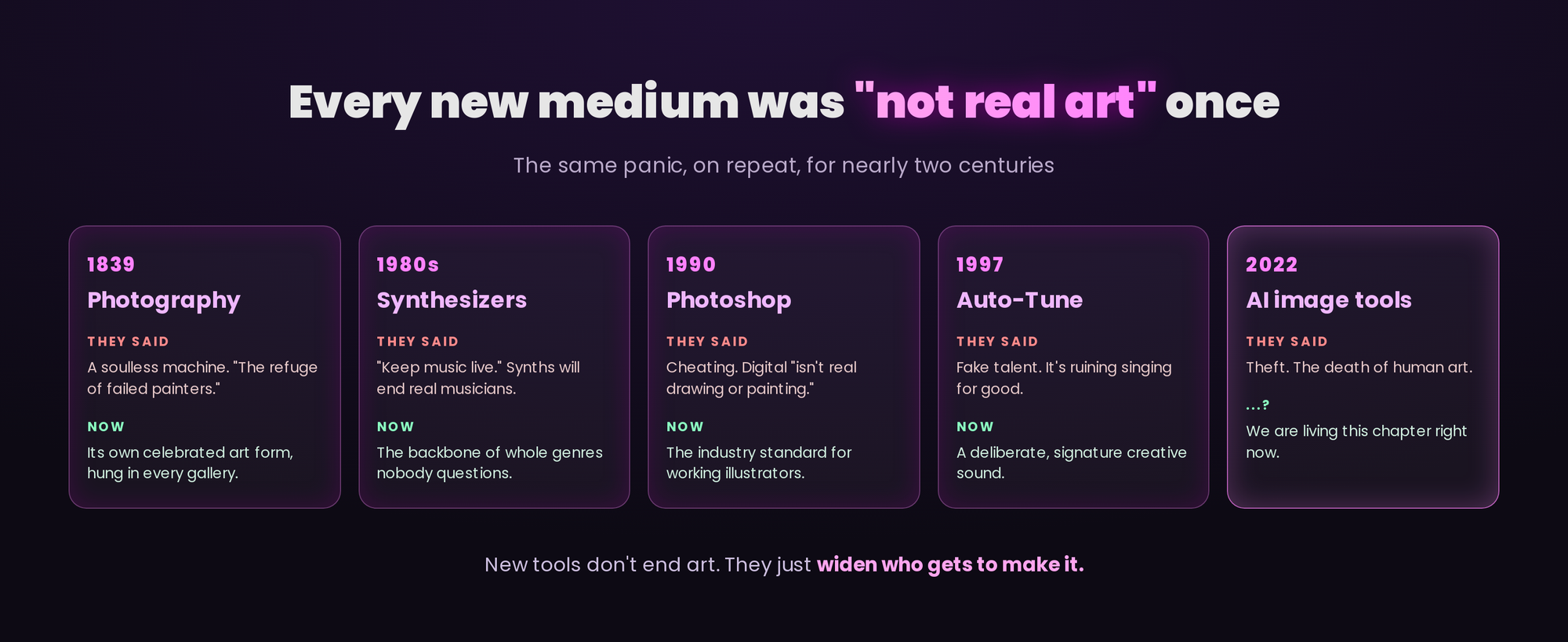
Photography was going to kill painting (it was called "mere mechanism"). Synthesisers were going to put real musicians out of work, and in 1982 the Musicians' Union literally tried to ban them with its "Keep Music Live" campaign. Sampling was "stealing" until it became the grammar of hip hop, after some real legal fights like Grand Upright v Warner. Auto-Tune was cheating until it became a deliberate sound. Photoshop and digital art were "not real drawing" until they became the industry standard.
The most important parallel, though, is the Luddites, because everyone gets them wrong. They were not anti technology. They were skilled workers furious at bosses using machines to cut them out, dodge standards and crush wages. That is the real lesson here, and it is the one I take most seriously. The fight over AI art is not really about pixels. It is about leverage, consent and who gets paid. A tool can be genuinely useful and still be deployed in a way that treats people badly. Both of those things are true at once.
The criticisms that actually land
I am not going to wave the problems away, because some of them are serious and the people raising them are not idiots. Here is the strong version of the case against, the bit AI fans should sit with.
The jobs are real jobs. This is not hypothetical. Rest of World reported Chinese game illustrators seeing their rates collapse to a fraction of what they were, hired only to tidy up the machine's output. The Society of Authors found a quarter of illustrators had already lost work to AI. When a client can generate infinite roughs for free, a lot of working artists lose their bargaining power overnight. That is a genuine harm, not whining.
The consent problem is simple and fair. "Publicly visible on the internet" was never meant to mean "free training fuel for a commercial product." The Greg Rutkowski story sums it up: his name became a popular prompt for making work "in his style", without permission, credit or a penny, to the point where he worried he would not be able to find his own work online any more. I would be livid too.
And some of it is genuinely dark. This is not all an aesthetics debate. The same tech drives deepfakes, non consensual imagery and misinformation, and the Stanford Internet Observatory found illegal abuse material inside a major training dataset. There is also the sheer environmental cost of running all this at scale, and the slow drowning of human work under a tide of low effort "AI slop". You can be pro tool and still take every one of these seriously. I do.
So why does the hatred run so deep?
Put all that together and the anger makes sense. It is not one complaint, it is a stack of them landing at once. In December 2022 ArtStation filled up with red "No to AI" images as artists protested on the very platform whose portfolios had trained the models. Communities from Newgrounds to Fur Affinity to r/Art banned the stuff. Valve made Steam developers prove their rights to AI assets. Wizards of the Coast got caught using AI art after saying it would not. Procreate's CEO drew a hard line and vowed never to add generative AI, to applause.
Underneath the slogans, the roots are consent, livelihood, identity and respect. Artists watched their work get taken, their style turned into a dropdown menu, their income squeezed, and their craft described as a button press, all at a speed nobody got to vote on. "AI art is soulless" is really "you took the thing I poured myself into and made it cheap." I do not think you have to agree with every protest to understand that, and have some sympathy for it.
A voice worth listening to
While I was writing this, I came across a blog post by an AI artist called Janna, who writes as loneicewolf, and it stuck with me. She is not a company or a tech evangelist. She is a person who has had a hard time of it, who stutters and writes instead of speaking, and who has spent a lot of time in hospital for serious treatment. She describes sitting in a recovery bed, waiting out grim side effects and frightening examinations, with AI art being the thing that gave her something to do and something to love in those hours. "I do AI-Art. And it is Art," she writes, and after reading the rest, I am not going to argue with her.
Her plea is a simple and fair one, and it lands very close to where I have. Disliking AI is completely fine, she says: "it is OKAY to dislike AI. Its a opinion. Its a choice." But hate, harassment, threats, and going out of your way to hunt down AI artists just to pile on them, that is something else, and she rightly points out it can cross into harassment and cyberstalking, which is a reportable crime. She has had threats herself, and the part that floored me is that she refuses to answer hate with hate. "My heart can't Hate," she writes. That is more grace than most of this argument manages.
I wanted to highlight her here because it is easy, in a fight about datasets and copyright, to forget there are real and often vulnerable people on every side of it. If you take one thing from her writing, let it be this: you can decide AI art is not for you and still be kind to the person who made it. You can read her blog post here, and you can follow her on Bluesky at @loneicewolf.bsky.social.
This one is personal for me too
I am not writing this from a safe distance. I have made and lost friends online over my use of AI. Not just AI art either, but using these tools for business, for my working practices, for the dozens of small ways they make my day easier when I am getting things done. For some people that was a line they could not have me on the other side of, and the friendship ended there.
And here is the thing worth saying plainly: it is often not really about art at all. A lot of the strongest reactions I have run into are not "I do not like AI art", they are "I do not like AI, full stop." The art is just the most visible flashpoint for a much bigger discomfort with the whole technology. Which is fair enough as a feeling. You are allowed to dislike where the world is going.
But choosing to throw a person away over it is a different decision. I understand it, and honestly I respect it, because it is their call to make and their line to draw. People get to choose who they keep around. I am not going to argue anyone out of their own values. What I will say is that when someone decides a friendship is worth less than my choice of tools, I think that says more about them than it does about me, or about anyone else who reaches for AI to make their life a little easier. I would never end a friendship over which software someone opens in the morning. That difference sits with me.
These are mine
I have talked a lot of theory, so let me show you the actual thing. Every image below is my own AI art, and here is the part that matters: they are all built from my own VRChat avatar. I uploaded screenshots of my own character, the one I wander around in, and asked AI to make cute versions of my own likeness. No other artist's work was taken to make these. They are just me, being a daft little catgirl, in moods and outfits I will never get to pose for in real life. This is the stuff people have actually dropped me over. Have a look and tell me where the victim is.
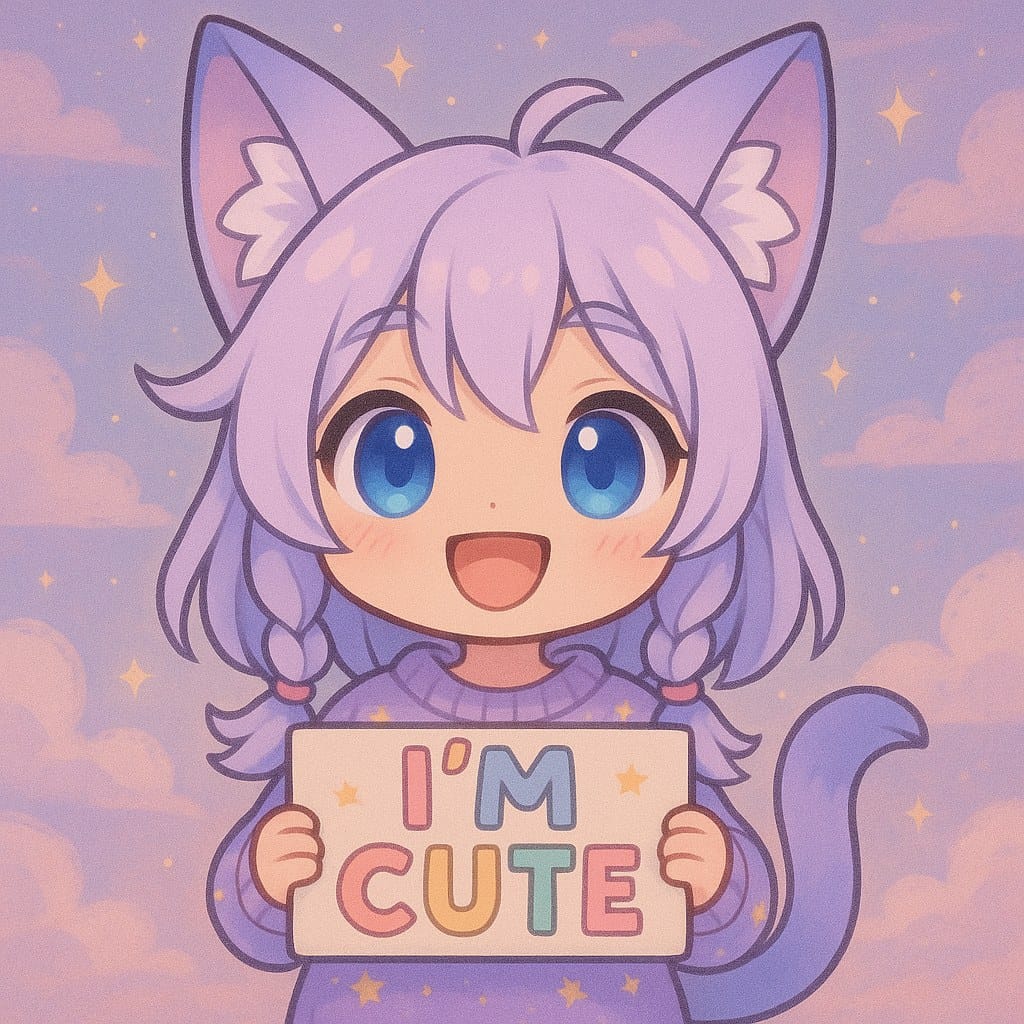




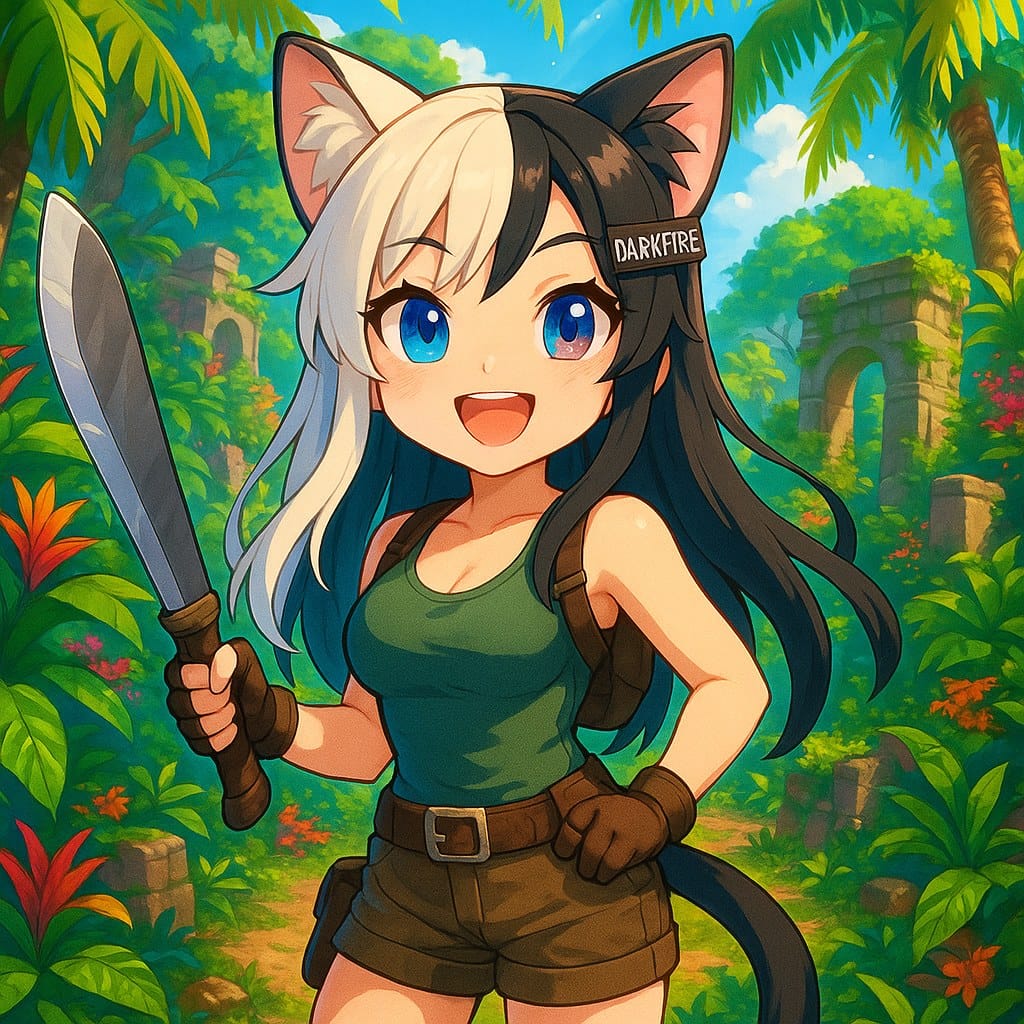
All me (and my friend Darkfire), all built from our own VRChat avatars. No notes.
The thing I will not budge on: label it
Here is where my outlet for non artists meets my respect for artists, and they meet at honesty. If AI made it, say so. That single habit fixes a huge amount of the bad blood.
Most of the world is already moving this way, so this is not some fringe demand. There is an open technical standard for it, C2PA Content Credentials, which the industry literally calls a "nutrition label" for media. The press uses IPTC metadata tags that say "Created using Generative AI". Meta, TikTok and YouTube all label AI content. The EU AI Act now makes disclosure a legal duty for some AI media, and the US Copyright Office requires you to disclaim the AI generated parts when you register a work. Marketplaces from Kickstarter to Etsy require sellers to disclose it.
Why does it matter so much? Because the moment you hide it, you are stealing something real, not training data, but trust. We have already seen how that goes. A piece made with AI won a state fair art prize and the judges only found out afterwards, and the rules had to change. A clear label protects everyone at once: the buyer knows what they are paying for, the human artist is not being undercut by something pretending to be handmade, and the AI work gets to stand honestly as what it is. Passing AI art off as hand made, or slapping your name on it like you painted it, is the one move I have no time for. Make it, enjoy it, sell it, but call it what it is.
Where I land
So, is AI art really art? When a person is behind it, choosing, shaping, iterating and giving it meaning, yes, in the same way a photograph is art. When nobody is home and it is just a prompt and a shrug, it is filler, the same as any other medium with nobody behind it.
Traditional artists are not going anywhere, and they should not. Their skill is real and the world is richer for it. AI has not changed that any more than the camera ended painting or the synth ended the orchestra. It is a new tool, an outlet for a lot of people who could never get the picture out of their head before, and like every tool before it, it can be used well or used badly. The technology is not the villain. Taking people's work without asking is, and pretending a machine made image is something it is not is too.
Keep making things by hand. Keep making things with the new tools. Just be honest about which is which, pay people, and label it. That is the whole of my view, and I think it is a fairer place to stand than either side of the shouting match.
Sources and further reading
- Getty Images v Stability AI, UK High Court 2025: bailii.org
- US Copyright Office, Copyright and Artificial Intelligence: copyright.gov/ai
- Carlini et al., Extracting Training Data from Diffusion Models: arxiv.org
- Glaze: glaze.cs.uchicago.edu and Nightshade: MIT Technology Review
- Burrow-Giles v Sarony (1884): Cornell Law
- Tate on conceptual art (Duchamp, LeWitt): tate.org.uk
- Harold Cohen and AARON, Whitney Museum: whitney.org
- The Luddites, Smithsonian: smithsonianmag.com
- Photography "was not art", JSTOR Daily: daily.jstor.org
- Musicians' Union and synthesisers: University of Stirling Archives
- AI and game illustrators, Rest of World: restofworld.org
- Society of Authors AI survey: societyofauthors.org
- Greg Rutkowski, MIT Technology Review: technologyreview.com
- Stanford Internet Observatory on LAION: purl.stanford.edu
- ArtStation "No to AI" protest and response: 80.lv
- Art communities banning AI, Waxy: waxy.org
- Valve and Steam AI policy, Game Developer: gamedeveloper.com
- Wizards of the Coast AI art, Polygon: polygon.com
- Procreate's anti generative AI stance, TechCrunch: techcrunch.com
- C2PA Content Credentials: c2pa.org and EU AI Act Article 50: artificialintelligenceact.eu
- State fair changes rules after AI win, Smithsonian: smithsonianmag.com
- Janna (loneicewolf), "Analysis On AI-Hate": loneicewolf.github.io, on Bluesky @loneicewolf.bsky.social