AI can do the task. Who gets to keep the job?
National employment data do not show an AI jobs apocalypse, but freelancers have already lost work, junior hiring bears watching, and public company corrections show why task gains are not headcount facts.


The argument about AI and jobs tends to arrive already shouting. One camp waves the technology away as fancy autocomplete; another has the office lights going out by Christmas. The labour data are quieter than either, though hardly reassuring enough to ignore. National employment remains broadly calm while some freelancers lose contracts and one large payroll panel shows weaker hiring into exposed work.
I use AI at work and find it useful, which makes me wary of both the sales pitch and the reflex to dismiss every productivity result. A tool can save me time while costing somebody else a contract; an economy can add jobs while making the route into a particular trade much harder.
A recent aggregate US analysis from Yale’s Budget Lab found no distinct break in occupational change after ChatGPT and no general relationship between its measures of AI exposure or use and employment or unemployment. The analysis is recent, has not been peer reviewed and covers a short period. Aggregate occupational data can also miss lost contracts, shorter hours and changes inside jobs.
The ILO’s wider review reaches a compatible conclusion across experiments, firm data, online platforms and representative surveys: work is changing and people are saving time on some tasks, but evidence of large-scale displacement remains limited through 2026. Many of the underlying studies are short and measure different things. The words through 2026 carry much of the weight here, because a description of the opening years cannot settle what happens over the next decade.
The distance between a task and a job
The distinction sounds academic until somebody uses a task result to justify cutting a team. Drafting a reply, summarising a meeting, checking an invoice and producing a standard block of code are tasks. A job includes those pieces along with the missing information, handovers, awkward customers, judgement calls, responsibility for mistakes and the slow business of learning what nobody wrote in the manual.
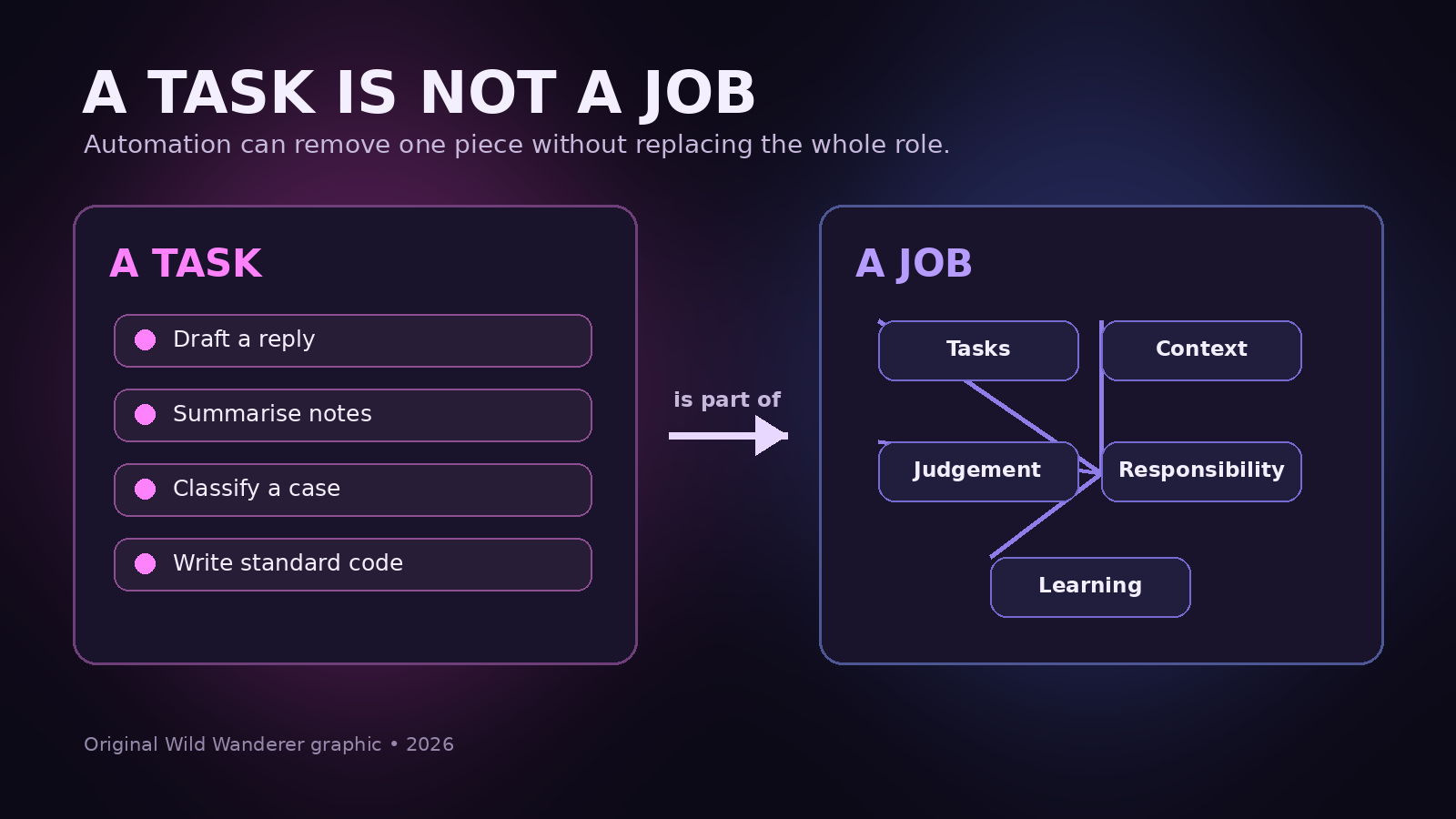
Software can take over part of that bundle and make a worker faster. It can also move the bottleneck to a reviewer, reduce recruitment without causing a dismissal, or leave the occupation intact while making the working day more demanding. None of these outcomes can be read directly from a benchmark score.
Displacement has a narrower meaning: paid work disappears because a machine substitutes for labour. A freelancer who loses regular commissions has experienced displacement even if national employment rises that month. A vacancy that is never opened can close a career route just as effectively as a redundancy, although it produces no photograph of somebody leaving an office with a cardboard box.
Exposure is further removed from an employment result. The ILO’s global index estimates that 25% of employment is in occupations with some overlap between generative AI capabilities and job tasks, with 3.3% in its highest-exposure category. These are estimates of technical overlap, not observed automation or a forecast of jobs that will disappear.
There are solid reasons to take task gains seriously. In a workplace study of 5,172 customer-support agents, an AI assistant raised issues resolved per hour by 15% on average. Less-experienced agents gained much more than their seasoned colleagues, and customer sentiment improved mainly for those newer workers. It is an encouraging result from a real support operation, but the study covered one company and one text-based workflow. It did not follow long-term wages, recruitment or headcount.
Widening the unit of measurement changes the picture. In a six-month experiment with 7,137 knowledge workers across 66 firms, people who used the assistant spent about two fewer hours a week on email and did less work after hours. Researchers detected no change in the quantity or composition of their broader work. The time saving was genuine, but it did not appear as a matching increase in organisational output.
Tidy staffing arithmetic starts to wobble when faster drafting creates more reviewing, testing or escalation. Once routine enquiries are filtered out, the remaining queue can be smaller but considerably harder. A company has to measure the whole process before it can know whether ten minutes saved at the front removes ten minutes of labour or merely sends the work somewhere less visible.
Where paid work has already gone
The clearest measured displacement I found is in an online freelance market. Researchers studying platform transactions after text and image generators appeared found that more-exposed freelancers received about 2% fewer monthly contracts and 5% lower monthly earnings. Strong previous ratings offered no protection in the short period studied.
This market makes substitution unusually easy because a buyer can replace a separable digital deliverable with generated output at little cost. I would not paste its percentages across permanent employment, but its unusual setting does not erase the income those workers lost. Calm national totals are a poor consolation when your own commissions are the part shrinking.
Recruitment may reveal pressure before redundancy figures do. An ADP payroll panel covering roughly 3.5 to 5 million US workers a month found that, after November 2022, employment among 22- to 25-year-olds fell about 11% in the two most AI-exposed occupational groups while rising about 10% in the other three. Most of the difference appeared in hiring rather than separations. It was larger in work classified as more open to substitution and concentrated in jobs based on documented rules and records rather than experience that is hard to write down.
The size of the gap makes the pattern worth watching, but it is not a secure estimate of AI’s effect. The sample overrepresents large firms and some industries, controlling for education reduces the gap, parts of the trend began before ChatGPT, and national surveys show a smaller divergence. The authors explicitly reject a definitive causal reading. For now, the result tells us where to watch and what to measure; it does not prove that AI caused an 11% decline.
Linked Danish evidence is a useful restraint on the American result. Researchers surveyed about 25,000 workers at 7,000 workplaces in eleven exposed occupations and connected their answers to administrative records. They reproduced an early-career employment decline, yet firms that actually adopted chatbots did not drive it in the study’s estimates. Over two years, the researchers could rule out average effects larger than 2% on earnings and recorded hours. Among users, 85% redirected saved time to other duties, and adopting firms added content, oversight, integration and policy tasks. A new duty is not necessarily a new job, nor does a small average rule out sharper losses for particular groups, but the study makes a simple collapse story much harder to sustain.
What three company cases can show
Company announcements invite mythology because workload equivalents quickly turn into claims about people hired or fired. I chose the following cases precisely because a public correction or workforce redesign was visible. There is no denominator covering every AI staffing plan, including the ones that worked, failed quietly or never escaped a presentation. These examples cannot tell us how often employers get their forecasts wrong or how a typical company responds.
Commonwealth Bank of Australia proposed 45 customer-service redundancies in July 2025 and linked them to an AI voice bot. After the union challenged the decision, CBA withdrew the proposed redundancies, apologised and admitted that it had not properly assessed the roles or all relevant business factors. Affected workers could remain, seek redeployment or leave.
The union said calls had increased after the bot arrived and that managers used overtime and moved team leaders onto phones. CBA did not publish operational data showing that the bot caused higher call demand, so those claims must remain attributed to the union and workers. The documented conclusion is narrower: the bank attached 45 proposed job losses to AI, then withdrew the proposal because its staffing assessment was inadequate.
Klarna’s 700 figure has travelled even further from its source. In 2024 the company said its assistant had handled 2.3 million conversations in a month, two-thirds of service chats and work equivalent to 700 full-time agents. Those unaudited company claims included a forecast $40 million profit improvement, while 700 described an equivalent workload rather than reported dismissals.
A year later, Klarna’s chief executive said cost had weighed too heavily and service quality had fallen. The company began a flexible human-support pilot so customers could reach a person, but only two people had started when the pilot was reported. Klarna still expected AI to handle much of the routine volume. We can document a quality problem followed by a small service redesign; the popular tale of 700 people being replaced and then rehired goes beyond the evidence.
IBM presents a different temptation: joining two announcements into a reversal that the record does not establish. In 2023 its chief executive said the company expected to slow or pause hiring in some non-customer-facing functions, with nearly a third of roughly 26,000 roles potentially automated or left unfilled through attrition over five years. The figure belonged to a five-year plan involving automation and attrition; it was never a record of 7,800 immediate dismissals.
IBM separately announced in 2026 that it planned to triple US entry-level hiring and redesign junior jobs around analysis, problem-solving and responsible AI use. The announcement records an intention rather than a verified hiring outcome, and gives us no basis to say that the 2023 plan failed, was abandoned or caused the later decision. Within those limits, a major AI adopter was still committing publicly to a pipeline of inexperienced human workers.
Keeping a job can still mean losing ground
Employment totals miss what happens during the working day. Software can clear dull paperwork and absorb routine abuse from customers. It can also set the pace, track every movement and leave people handling a diet of exceptions, complaints and machine errors.
Company records from before the generative-AI boom showed an automated system tracking individual productivity and issuing warnings or terminations at one Amazon warehouse in Baltimore. About 300 full-time workers were dismissed for productivity reasons over 13 months. The case says nothing about every Amazon site, but it shows how software can tighten control over workers who remain essential to the physical job.
A nominal human reviewer offers little protection when that person cannot inspect the evidence, has seconds to decide or lacks authority to change the outcome. In Moffatt v Air Canada, a chatbot gave a customer incorrect advice about a bereavement fare. The airline rejected the claim, the customer pursued a tribunal case, and Air Canada was held responsible for information on its own website.
One tribunal decision cannot tell us how often chatbots make mistakes, but this one exposes a form of cost shifting in which the organisation saves time while the customer detects the error, gathers evidence and runs the appeal. I expect that burden to fall harder on people with less spare time, money or access to advice. I infer this from unequal ability to challenge a decision; the Air Canada case itself does not measure the burden across income groups.
What I expect, and where confidence runs out
My best reading for the next three to five years is constrained augmentation. AI will alter parts of many jobs and remove some contracts or vacancies, while people remain in most established roles because whole workflows are far messier than benchmark tasks. I have more confidence in that direction than in any estimate of how many jobs will be gained or lost.
The models are improving quickly enough that METR estimated the length of software-heavy tasks a model could complete with 50% success doubled about every seven months between 2019 and 2025. The benchmark tasks are unusually clean, self-contained and often scored automatically, and METR warns that its longer measurements are less reliable. An eight-hour task horizon cannot be translated into somebody’s eight-hour shift, with private company knowledge, interruptions, legal responsibility and the peculiar exception that last appeared in March.
Firms also have old software, fragmented records, security rules and processes held together by the digital equivalent of string. Cheap model output does not remove the fixed cost of connecting those systems or deciding who carries the risk when they disagree. Broad adoption can therefore coexist with shallow use and very little autonomous work.
I would revise this near-term view if firms showed sustained output gains alongside large, well-measured falls in labour hours, or if independent tests found agents completing varied, messy, multi-day work reliably with little supervision. Current benchmark progress has not yet supplied either result across the economy.
The larger economic unknown is whether cheaper services attract enough new business to keep people working and whether substantial new paid tasks appear. History gives that argument weight: a majority of US employment in 2018 was in job specialities introduced after 1940. Yet the same historical research found that newer work since 1980 had moved away from middle-paid production and clerical roles towards high-paid professional jobs and lower-paid services. Employment can recover while the ladder in the middle loses rungs.
No economy-wide dataset currently shows whether extra demand and new tasks will absorb the hours generative AI saves. That missing evidence leaves both painless-abundance stories and confident mass-redundancy forecasts reaching beyond what we know.
Over roughly five to fifteen years, uneven displacement looks more plausible to me than either a return to business as usual or rapid substitution across the whole economy. Pressure is likely to collect around work that can be separated, specified and checked on a screen. Freelance writing and image work offer an early example. Clerical roles, standard support, routine business processing and parts of software or professional production belong on a watchlist, but the evidence does not show all of those workers losing jobs today.
Exposure also cuts across the old idea that automation mainly threatens factory work. The ILO estimates greater exposure for women in high-income countries because many work in clerical roles. Pew’s US analysis found degree holders more than twice as likely as people with only a high-school education to be in its highly exposed group. A laptop and a degree no longer provide automatic shelter.
Responsibility, trusted relationships, institutional memory and work in changing physical settings all make jobs harder to compress into clean digital processes. They do not guarantee safety, good pay or bargaining power. A society can badly need carers without funding enough posts, and a plumber can be difficult to automate while having little control over rates or conditions. Specialised robots are spreading through structured factories, but those installations tell us little about when a cheap general-purpose machine will cope safely in any home or worksite.
Hiring freezes, thinner contractor markets and missing starter jobs may do much of the early damage without making whole occupations vanish. Beyond fifteen years, the technical capability, speed of organisational change and response of demand are too uncertain for me to rank the scenarios. A precise employment percentage for 2045 is confidence dressed as measurement.
Who gets the saved hour
Even a stable job total can conceal a widening gap. The IMF estimates that about 40% of global employment is exposed to AI, rising to 60% in advanced economies. Exposure is not displacement, and its macroeconomic results depend on assumptions about adoption and whether AI complements or substitutes for labour. Within those models, stronger returns to capital can widen wealth inequality even when some workers earn more.
Ownership determines who is best placed to claim the saving. A firm that controls the model access, customer relationship and redesigned workflow can keep more of the benefit as profit, while policy can alter that distribution. Researchers used a firm-size threshold to study a French profit-sharing rule. The rule raised the share of company income going to workers by 1.8 percentage points and increased compensation for lower-skilled workers, with no statistically significant effect on investment or productivity. One French rule cannot identify the right policy elsewhere, but it does show that productivity and distribution are separate choices.
Workers also know where the demonstration will fail on a wet Tuesday afternoon: which record is unreliable, which exception causes harm and which shortcut moves work to another team. In OECD surveys of 5,334 workers and 2,053 firms in manufacturing and finance across seven countries, training and worker consultation were associated with better reported outcomes. The surveys were cross-sectional and cannot prove that consultation caused the improvement. Their limited sector and country coverage also rules out treating the association as an economy-wide law.
The route into expertise needs the same attention. Junior work is often repetitive because repetition is how people learn. In a small randomised experiment, 52 developers used AI while learning an unfamiliar Python library and later scored 17% lower on tests of conceptual understanding, code reading and debugging, with no statistically significant average time saving. The artificial setting and small sample cannot establish profession-wide skill decline. They do give employers a concrete reason to measure learning instead of assuming that faster output preserves it.
Employers can retain supervised practice, let trainees tackle difficult cases with support, test unaided competence and count mentoring as productive work. IBM’s entry-level plan is interesting in this context because a company investing heavily in AI still says it needs a human talent pipeline, although the plan remains a plan until the hiring happens.
I expect AI to remove a meaningful amount of paid work and make many more jobs feel stranger and less forgiving. I don’t expect offices to empty overnight. The losses are more likely to accumulate first among people with the least room to absorb them unless workers gain some influence over how jobs, training and rewards change.
When a company saves an hour with AI, that hour can become profit, a shorter working week, better service or one fewer starter job. The model may create the saving, but people decide whose hour it was and who receives the benefit.